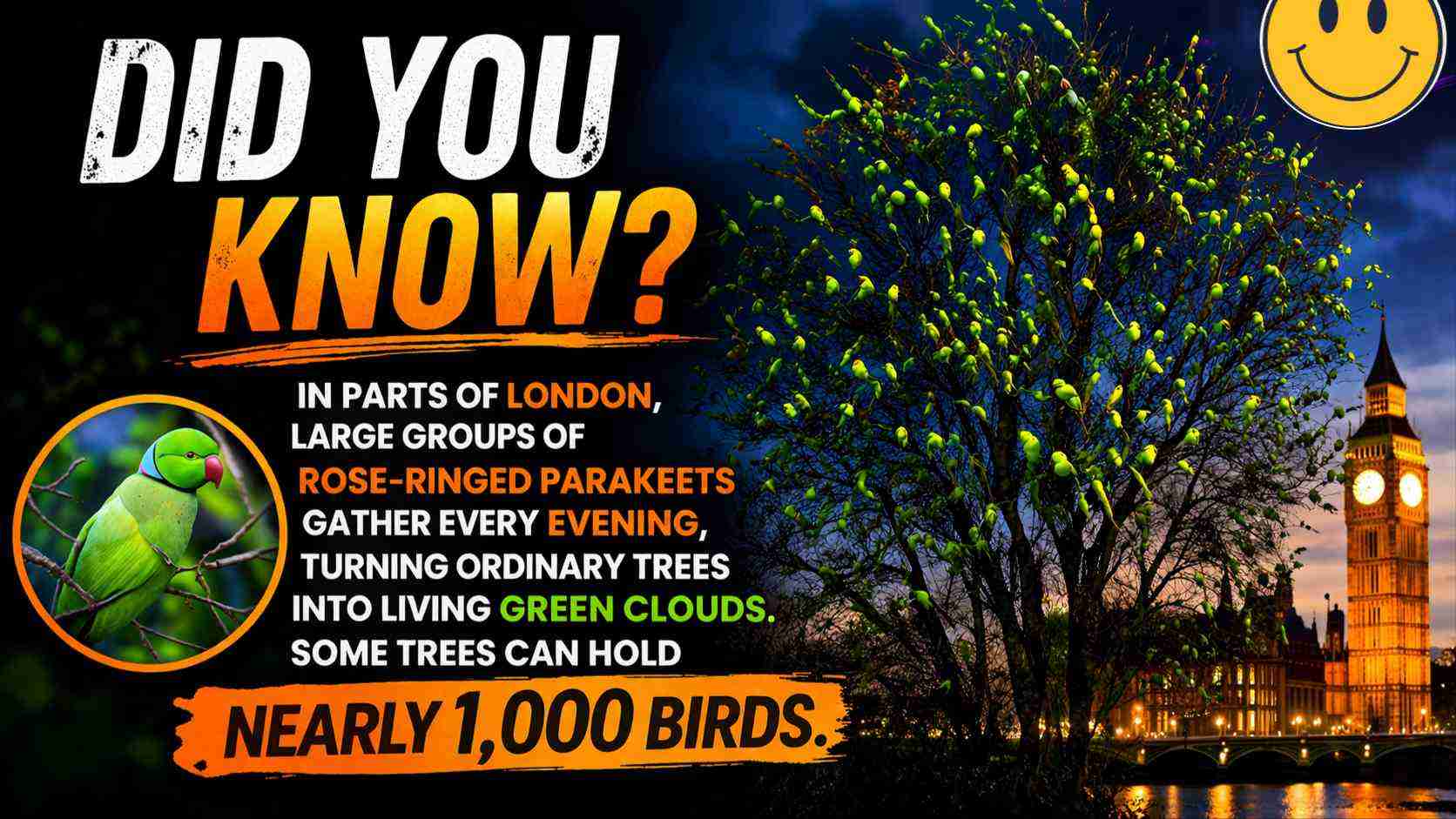

As the sun dips below the horizon over London’s parks and suburban streets, an extraordinary transformation unfolds in the trees. What appears at first glance to be a dense canopy of fresh green leaves suddenly reveals itself as something far more dynamic: thousands of bright emerald bodies settling in for the night. These are rose-ringed parakeets (also known as ring-necked parakeets), whose massive communal roosts turn ordinary urban trees into living, shifting clouds of colour and sound. The spectacle is impossible to ignore—their loud, piercing calls echo through the dusk, stopping passers-by in their tracks and reminding everyone that nature thrives even in the heart of one of the world’s busiest cities.
Rose-ringed parakeets (Psittacula krameri) are not native to the UK. Originally from the warmer climates of the Indian subcontinent and parts of sub-Saharan Africa, they were brought to Britain through the pet trade over many decades. Escapes and deliberate releases, particularly from the mid-20th century onward, allowed small groups to establish breeding populations. The first confirmed wild breeding occurred around 1969 in the south-east London and Kent area. From those modest beginnings, the birds have exploded in number. Estimates suggest there are now around 8,600 to 12,000 breeding pairs across the UK, with the vast majority concentrated in and around London and the Home Counties. Large winter roosts once numbering several thousand birds each have become a hallmark of the capital’s green spaces.
Why Do They Gather in Such Huge Flocks?
Scientists believe these communal roosts serve multiple purposes: warmth during colder months, safety in numbers against predators, and social interaction. In the wild, the species is highly gregarious, and London’s urban environment has proven ideal for them. The city’s milder microclimate, abundant food from gardens, parks, and bird feeders, plus plenty of mature trees with nesting cavities, have allowed the parakeets to thrive where many other exotic species might struggle. Some roost sites, such as poplars at Hither Green Cemetery or trees in Richmond Park, Hyde Park, and Brockwell Park, can host hundreds to several thousand birds at once. Individual trees have been known to hold close to 1,000 parakeets, creating a vivid green spectacle against the evening sky.
At dusk, the show begins in earnest. Small groups and larger squadrons fly in along regular “commuter” routes, often covering several kilometres from daytime feeding grounds. They circle noisily before dropping into the chosen trees, jostling for position with constant chatter. The sound—a mix of sharp “kee-ak” calls—can be deafening, yet it adds a wild, almost tropical energy to otherwise ordinary streets and parks. For a few minutes, the city feels transformed, as if a slice of rainforest has temporarily taken root amid the brick and concrete.
This blend of nature and urban life is one of London’s most delightful surprises. Long-time residents may have grown accustomed to the flash of green and the raucous calls, but for visitors or newcomers, the sight remains magical. One moment, a quiet residential road or park path seems unremarkable; the next, it pulses with vibrant colour, movement, and sound. The parakeets have effectively “commuted” their way into the fabric of London life, following predictable flyways much like the human workers heading home.
Adaptation and Concerns
Their success highlights the adaptability of the species. Rose-ringed parakeets are intelligent, opportunistic feeders that exploit everything from fruit trees and seeds to garden feeders. They nest early in the year—sometimes as soon as January—giving them an edge in securing prime tree holes. While their presence brings joy to many birdwatchers and photographers, it has also sparked debate. As an introduced species, concerns exist about potential competition with native cavity-nesters like nuthatches, woodpeckers, or even bats for nesting sites, as well as dominance at feeders. However, studies in the UK have so far found limited evidence of significant population-level impacts on native birds, with broader factors like habitat loss and climate change playing larger roles in declines of other species.
Regardless of the ecological nuances, the evening roosts remain a captivating reminder of wildlife’s resilience. In a metropolis often criticised for its disconnection from nature, the parakeets offer a vivid, living connection. They turn bare winter branches into glowing green spectacles and fill the twilight with exotic calls that feel both out of place and perfectly at home.
Next time you find yourself in a London park as darkness falls, pause and look up. You might witness an ordinary tree become something extraordinary—a bustling, noisy, emerald cloud of life. In that brief, chaotic moment, the city briefly forgets it is not a rainforest, and London reveals one of its most charming secrets: even in concrete jungles, nature finds a way to flourish, loudly and colourfully.